
The “Melnyk Controversy” as a Case Study in Disinformation, Historical Memory and Missing Ukrainian Voices.
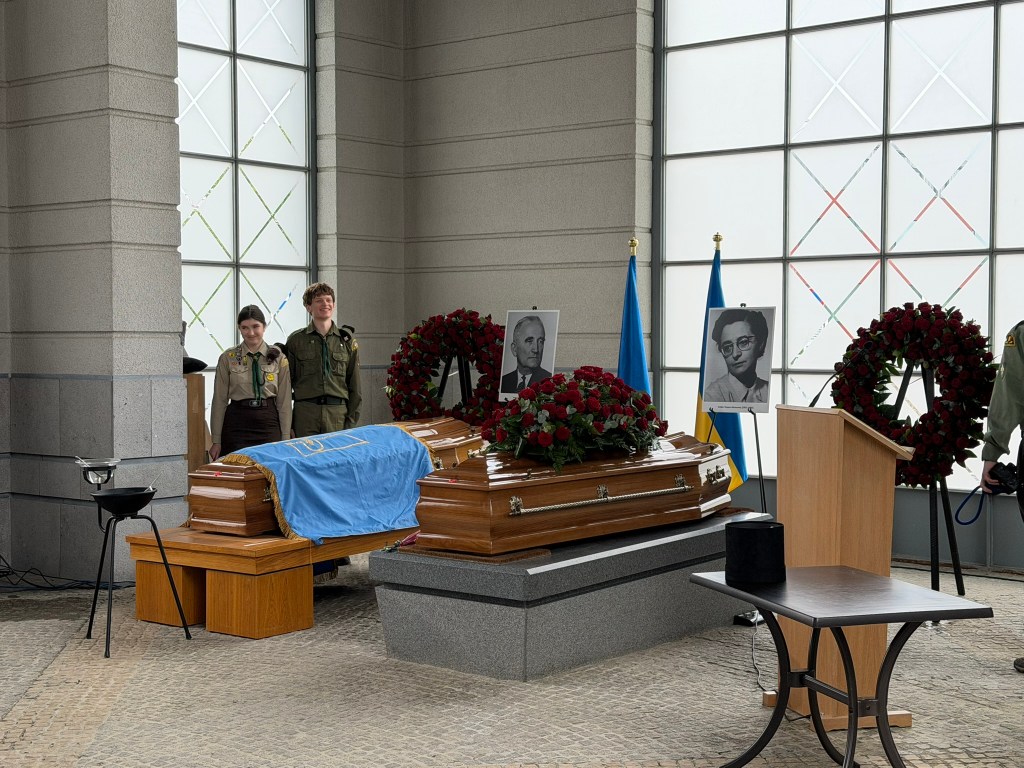
(c) Philippe Schockweiler
(Luxembourg): The debate surrounding the reburial of Andriy Melnyk from Luxembourg to Kyiv exposed more than disagreements about history. It revealed how easily Ukrainian voices are excluded from discussions about Ukraine, how readily Russian narratives can shape public debate, and how poorly Luxembourg still understands the information war being waged on its doorstep.
As a journalist, I have spent many years covering Ukraine, its history, its politics and, more recently, its war. Yet my connection to this ceremony was also deeply personal. The cemetery of Bonnevoie is a place I have visited countless times throughout my life, for a simple reason: it is where much of my own family rests. The grey walls of the cemetery chapel are familiar to me, not through history books or political debates, but through moments of mourning and remembrance. That is why the recent reburial has become yet another sad memory associated with this place. Not because of the ceremony itself, but because it snowballed into an unusually bitter public debate in my home country and far beyond its borders and exposed how easily and quickly Russian propaganda can fill the void if we don’t get it right.
Too often, when we talk about Ukraine, we do not talk with Ukrainians. The controversy surrounding Melnyk’s reburial quickly became a subject of discussion in Luxembourg. Local media covered the story. The Russian embassy commented on it. Russian state-affiliated accounts amplified it online. Predictably, the discussion soon became less about history and more about political narratives.
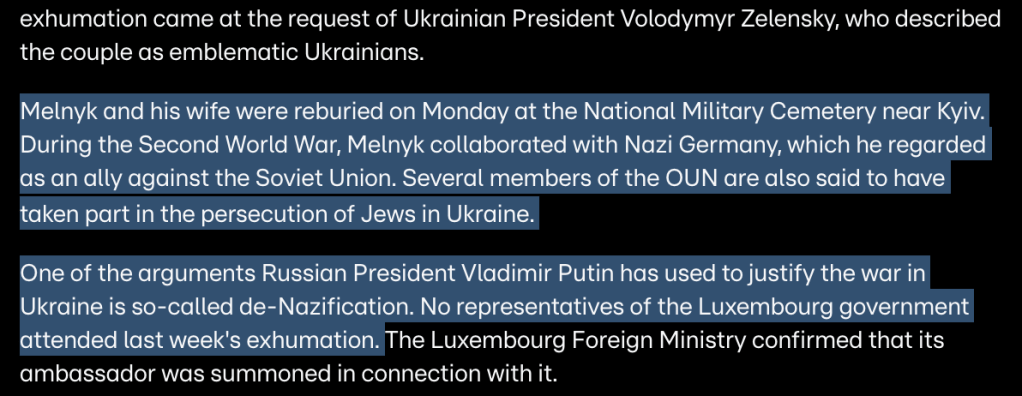
What struck me most was not the existence of criticism. Criticism is legitimate. Historical figures should be examined critically. No society benefits from sanitizing its past. What struck me was how many people were willing to speak about Ukraine without speaking to Ukrainians. Several major Luxembourgish articles discussing the issue relied almost entirely on non-Ukrainian sources, some of them carrying a long history of anti-Ukrainian bias. No Ukrainian historians were interviewed. No Ukrainian academics specializing in twentieth-century history were consulted. No Ukrainian memory scholars were asked for their perspective. No attempt was made to understand how this debate is currently being conducted inside Ukraine itself, instead just the view of Russia on this question as seen here in an article for RTL:
This is particularly striking given that Luxembourg itself is home to Ukrainian scholars working on exactly these questions. Historian Zhanna Serdiuk, based at the University of Luxembourg, has published extensive research on Sofia Fedak, Melnyk’s wife and also philosophical and political confidante, Luxembourg and the broader historical context surrounding his exile. Her work is publicly available. Yet voices such as hers were largely absent from the public discussion.
The issue here is not agreement or disagreement. It is expertise and facts. Imagine discussing Luxembourg’s wartime history without consulting Luxembourgish historians. Imagine writing about the Holocaust without speaking to Holocaust scholars. Imagine covering the Resistance on hearsay and basing yourself on movies and comics while ignoring those who have spent years researching it. Most editors would immediately recognize the problem: Yet when the subject is Ukraine, this often appears to be considered acceptable. There is also a striking asymmetry at work. Europeans routinely expect Ukrainian experts to comment on Ukraine’s war, politics, society and future. But when the subject shifts to Ukrainian memory, history or identity, Ukrainian voices often disappear from the discussion and are replaced by outside interpretations. The people closest to the debate suddenly become spectators in a conversation about themselves. Instead, readers were presented with a simplified narrative that closely mirrors a framework promoted by Russian state propaganda for years.
This does not mean that journalists or commentators consciously repeat Russian talking points. Most do not. But narrative convergence is a real phenomenon. When complex historical questions are reduced to a single label, when historical context is stripped away, and when Ukrainian expertise is excluded from the discussion, the resulting narrative can begin to resemble one that Russian propaganda has spent decades promoting.
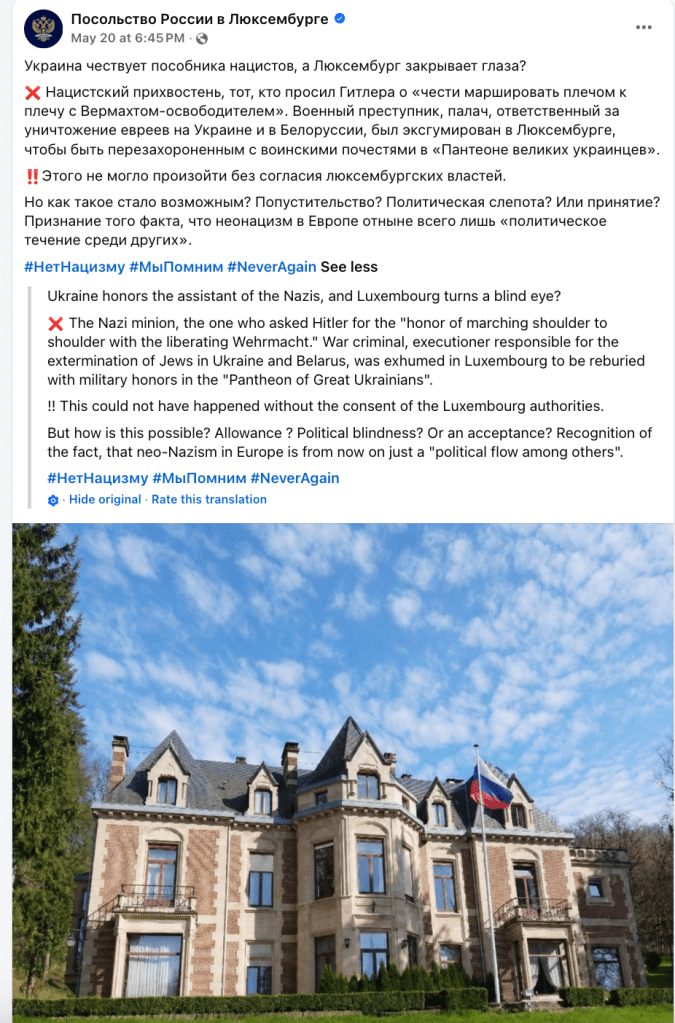
One does not have to look far to see how this works. Following the reburial, the Russian embassy in Luxembourg publicly promoted a particular interpretation of Melnyk’s legacy. Around the same time, similar themes began appearing across parts of the public debate: a focus on a single aspect of his biography, the absence of broader historical context, and the reduction of a complex historical figure to a single political label. This does not prove coordination. It does not mean anyone became a mouthpiece for the Kremlin. But it should raise an important question: if the conclusions of our public debate become indistinguishable from the narratives promoted by Russian state actors, have we done enough work to understand the subject?
This is not a question of defending Melnyk. It is a question of defending historical accuracy.Yes, Melnyk’s political biography contains chapters in which he sought cooperation with German authorities. These deserve scrutiny. They deserve debate. They deserve criticism. But history does not stop where our preferred narrative begins. This lazy black-and-white thinking is one of the major challenges of our time. If one mentions collaboration but omits his later imprisonment by the Nazis, including his detention in Sachsenhausen concentration camp, the picture becomes distorted.
If one discusses Ukrainian nationalism but ignores decades of Soviet occupation, political repression, cultural destruction, language suppression, deportations, executions, the Holodomor and other crimes such genocide committed against Ukrainians, the picture becomes not just distorted but false. If one examines Eastern European history exclusively through the lens of German National Socialism while ignoring brutal Soviet imperialism and expansion, the picture becomes distorted.
And when distortion becomes systematic, it ceases to be history and becomes narrative.This matters because Russia has invested enormous resources into promoting exactly such simplified narratives. For years, the Kremlin has sought to reduce Ukrainian history to a handful of accusations: that Ukrainians are “Nazis”, that Ukraine is an artificial state, and that Ukrainians are incapable of self-government.
The goal has never been historical understanding. The goal has been delegitimization. That is why journalists, scholars and commentators have a particular responsibility. They do not have to agree with Ukrainian interpretations of history. They do not have to support reburials, memorials or pantheons. But they should engage with Ukrainian scholarship before reaching conclusions about Ukrainian memory.
Ironically, while Luxembourgers were passionately debating the legacy of a Ukrainian historical figure about whom many had only recently learned about, often through media reports that closely echoed the framing promoted by the Russian Embassy – new research was also drawing attention to Luxembourg’s own complex relationship with the Waffen-SS and the hundred of willing Luxembourgers joining the ranks.
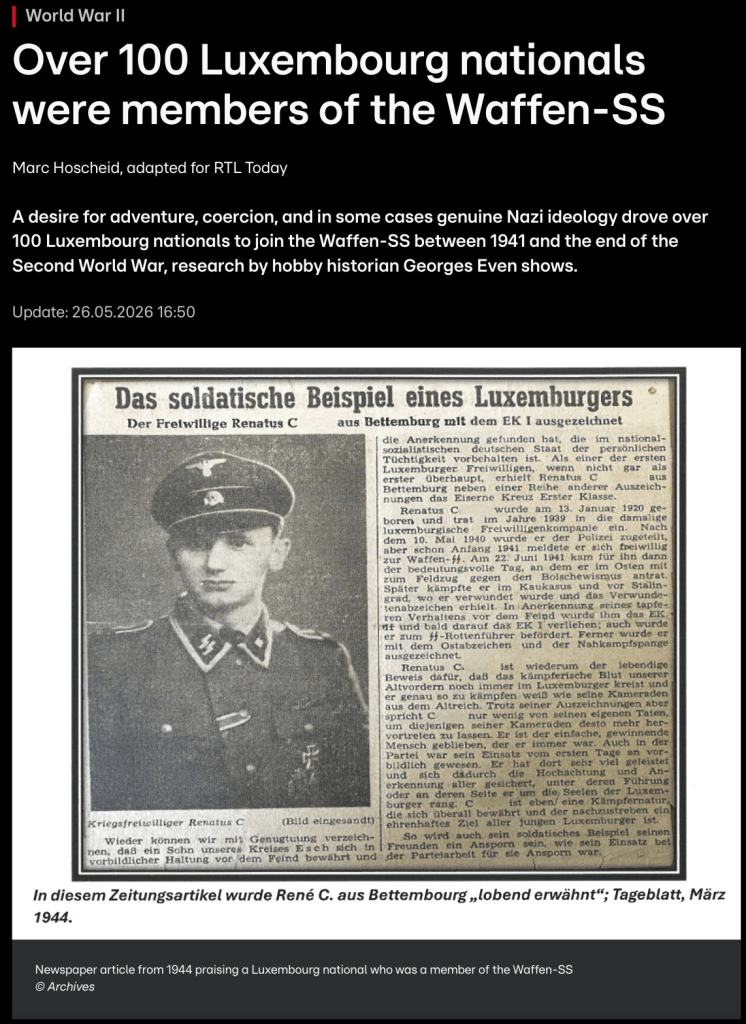
Like every European society, we still have difficult conversations to conduct about our own history. That is not an argument against examining Ukraine’s past. It is an argument for approaching it with a little more humility.
The debate surrounding Melnyk’s reburial has also exposed divisions among Ukrainians themselves. Some support the reburial. Some oppose it. Some do not consider it particularly important. Others reject the broader idea of creating a national pantheon altogether. Some see it as a populist move. Others see it as an attempt to reconcile with a difficult past while living through Europe’s largest war since the Second World War.
Personally, I do not believe it is my role as a Luxembourger to determine how a nation fighting for its survival should construct its historical memory. That conversation belongs first and foremost to Ukrainians. What I can observe, however, is that these debates are taking place openly. Ukrainians argue passionately. They criticize each other. They challenge institutions. They challenge political leaders. They challenge historians. They challenge themselves.
For me, this remains one of the strongest signs of a living democratic society. Try doing that in Russia: In Russia, history is an affair of state rather than an academic matter. Historical narratives are prescribed from above, while those who challenge them risk professional ruin, prosecution, exile or imprisonment. Debate is treated as disloyalty. Discussion becomes obedience, it’s heartbreaking that in the comment sections of the internet, Luxembourgers shout with the same arguments against Ukraine.
The real lesson of this controversy is therefore not about Melnyk. It is about listening to the side of the story you haven’t heard or don’t want to hear: After more than four years of full-scale war and centuries of imperial domination, Europe should be capable of discussing Ukraine without reducing it to slogans. Ukraine does not need historical whitewashing. It does not need uncritical support. It does not need outsiders to agree with every decision made in Kyiv. What it does need is a conversation grounded in facts, expertise and intellectual honesty. If we talk about Ukraine, we must talk with Ukrainians and listen to their voices, their expertise, their history.
We must also be prepared to challenge narratives that originate in Moscow’s propaganda apparatus and that have, for decades, sought to delegitimize Ukrainian identity, statehood and history. Leaving Ukrainians yet again out of the discussion and giving them 0 agency will guarantee that the picture will remain incomplete and probably factually wrong.
The final irony of this debate was Russia’s very public summoning of Luxembourg’s ambassador in Moscow over the reburial. It was a reminder that the Kremlin does not view questions of history as academic debates. It views them as instruments of influence and foreign policy. Luxembourg renounced in extending the same to the Russian Ambassador in Luxembourg.
Philippe Schockweiler.
NB:
Privately exchanged my views with some of the journalists that were in charge of writing these articles.


Leave a comment